
For businesses in Alabama, professional Alabama hard drive shredding is the only way to be absolutely certain that sensitive data on retired IT equipment is gone for good. Just hitting 'delete' or even reformatting a drive isn't enough—it often leaves recoverable information behind. That creates a huge security risk that can lead to expensive data breaches and stiff penalties for non-compliance with commercial data protection laws.
Why Shredding Hard Drives Is a Business Necessity
Failing to properly destroy data on old hard drives is more than a simple mistake; it’s a critical business risk with very real consequences. In an environment where a single data breach can cost a company millions, viewing data destruction as a mere operational expense is a dangerous gamble. Consider this: a single retired server can hold client lists, financial records, employee PII, and trade secrets. To a threat actor, that's a goldmine.
For companies in Alabama, the risks are magnified by a complex web of federal regulations that demand secure data disposal for commercial entities. These aren't just suggestions; they're strict laws with serious financial penalties for non-compliance.
Here are a few key regulations that impact Alabama businesses:
- HIPAA (Health Insurance Portability and Accountability Act): If your business handles protected health information (PHI), improper disposal can lead to fines climbing as high as $1.5 million per violation.
- GLBA (Gramm-Leach-Bliley Act): Financial institutions have a legal duty to protect consumer financial data. Failing to do so through secure data destruction can bring on fines, lawsuits, and in some cases, even criminal charges.
- FACTA (Fair and Accurate Credit Transactions Act): This act requires businesses to destroy consumer information before disposal. A key part of FACTA, the FTC Disposal Rule, specifically calls for methods like shredding to make sure data is unreadable and impossible to recover.
Beyond the legal headaches, the damage to your reputation from a data breach can be permanent. Customers and partners trust you with their information. A public breach shatters that trust in an instant, hurting your brand and your bottom line for years. Secure data destruction is one of the most essential security solutions for businesses because it protects your digital assets from creation to final destruction.
Real-World Scenarios and Consequences
Let’s make this real. Imagine a healthcare provider in Birmingham upgrading its servers. If those old drives are just wiped and handed off to an uncertified recycler, any lingering patient data could be easily extracted. That one mistake could trigger a massive HIPAA fine and completely demolish the provider's reputation in the community.
Or consider a manufacturing company near Mobile that disposes of old laptops containing sensitive R&D plans. If those drives fall into the wrong hands, the company’s competitive edge could vanish overnight.
Proper hard drive shredding prevents these nightmare scenarios. It physically demolishes the storage platters, making data recovery completely impossible. When you combine this practice with a solid IT asset disposal strategy, like the one we detail in our guide to Alabama e-waste disposal, you create a secure, airtight end-of-life process for all your company's electronics.
Choosing Between On-Site And Off-Site Shredding Services
So, you've decided professional hard drive destruction is the only way to go. Smart move. Now comes the next big question: where does the actual shredding happen? For businesses in Alabama, it really boils down to two options: on-site mobile shredding or off-site plant-based shredding.
There's no single "best" answer here. The right choice for your company will hinge on your specific security needs, any compliance regulations you're up against, and, of course, your budget. Let's break down what each commercial service looks like in the real world.
On-Site Shredding: The Gold Standard for Verification
This is exactly what it sounds like. We bring the shredder to you. A specialized, high-powered shred truck pulls right up to your facility in Huntsville, Mobile, or anywhere in between, and we destroy your hard drives right there at your location while you watch.
This method gives you unparalleled peace of mind. You can literally witness every single drive get fed into the shredder and turned into tiny, irrecoverable pieces of metal.
For organizations in healthcare (think HIPAA) or finance, this level of transparency isn't just a nice-to-have; it's often a requirement. It provides a completely unbroken chain of custody that you can see with your own eyes, eliminating any and all risks during transport. Your team can watch the entire process, satisfying even the most demanding internal auditors.
Of course, this level of convenience and security comes at a higher price point. The logistics of bringing heavy industrial machinery to your location means on-site shredding is typically the more expensive option per drive.
When you're looking for this kind of service, you have to be sure the vendor's process is as tight as they claim. You can see the rigorous security standards we follow by checking out our on-site data destruction services.
Off-Site Shredding: Efficiency and Cost-Effectiveness
Off-Site shredding is an incredibly secure—and more budget-friendly—alternative. With this model, we come to your Alabama office and collect your hard drives in locked, tamper-evident containers. From there, they're transported in a GPS-tracked, secure vehicle to our specialized destruction facility.
Don't mistake "off-site" for "less secure." The security protocols are just as strict, if not more so. We maintain a documented chain of custody from the moment we pick up your assets to their final destruction, and our entire plant is monitored by 24/7 video surveillance.
The process is built for efficiency. Because all the shredding happens at a centralized, high-volume facility, we can process drives much more economically. This makes off-site services significantly more affordable, especially when you have a large number of drives to destroy.
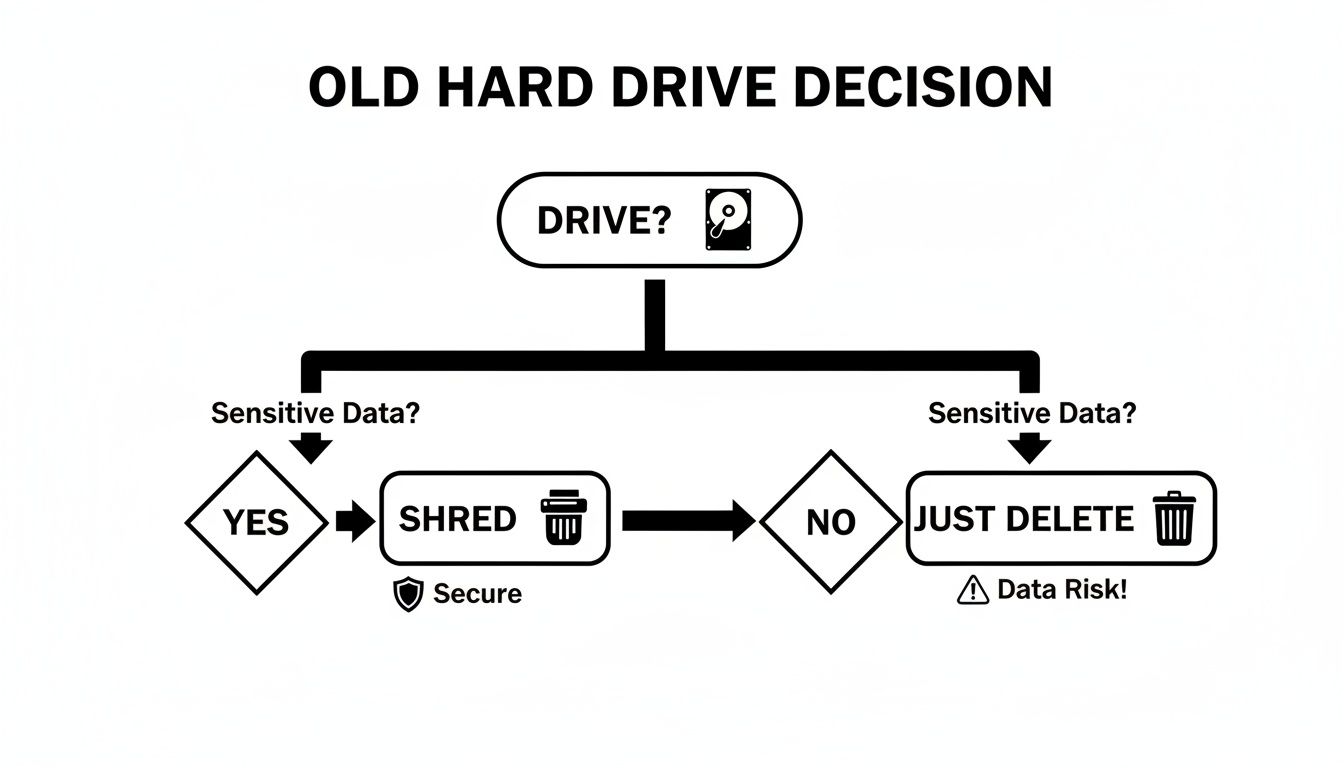
This flowchart puts the choice into perspective: for sensitive data, simple deletion is a gamble, while physical shredding is the only sure bet.
After the job is done, you still receive the exact same ironclad Certificate of Destruction. This legal document confirms your data has been permanently eliminated, giving you the proof you need for any compliance audit. It's the perfect solution for businesses that need top-tier security without the premium price tag.
Comparing On-Site vs. Off-Site Hard Drive Shredding
To make the decision clearer, here’s a straightforward comparison of the key features for Alabama businesses considering mobile versus plant-based hard drive destruction.
| Feature | On-Site Shredding | Off-Site Shredding |
|---|---|---|
| Location | At your facility (parking lot, loading dock) | At a secure, specialized shredding plant |
| Verification | Direct visual confirmation of destruction | Documented chain of custody, video surveillance |
| Security | Unbroken chain of custody, no transportation risk | Secure, locked transport with GPS tracking |
| Cost | Higher price per drive due to logistics | More cost-effective, especially for large volumes |
| Best For | Maximum security, compliance mandates (HIPAA, FTC) | Budget-conscious businesses, large quantities |
| Documentation | Certificate of Destruction issued on-site | Certificate of Destruction issued after processing |
Ultimately, both paths lead to the same result: your data is gone forever. The choice simply comes down to whether you prefer to watch it happen right in front of you or are comfortable with a documented, highly secure process that saves you money.
Navigating Data Destruction Compliance In Alabama
For any business in Alabama, securely destroying data isn't just a good idea—it's a legal minefield. Simply disposing of an old hard drive can expose your company to massive liability, leading to staggering financial penalties and a reputation that’s hard to rebuild. Getting a handle on these rules is the absolute first step toward a data security plan that will actually hold up under scrutiny.
Alabama’s regulatory scene is a unique beast. We don't have a specific state law for e-waste recycling, but that doesn't mean your business is off the hook. Far from it. Federal laws like HIPAA, GLBA, and PCI DSS are in full effect, demanding verifiable data destruction. Violate them, and you're looking at fines that can cripple a business. At the same time, The Solid Wastes and Recyclable Materials Management Act (SWRMMA) is pushing businesses toward certified IT asset disposition to meet waste reduction goals.
For a deeper dive, check out this guide on Alabama's enterprise data destruction laws on datadestruction.com.
Core Federal Mandates Affecting Alabama Businesses
Several heavy-hitting federal laws dictate exactly how your business must handle sensitive data when it's time to retire the hardware. These aren't just suggestions; they have the full force of law behind them.
- The FTC Disposal Rule: Stemming from the Fair and Accurate Credit Transactions Act (FACTA), this rule is crystal clear. Businesses must take "reasonable measures" to destroy consumer information so it can't be pieced back together. Physical destruction, like shredding, is specifically named as a compliant method.
- HIPAA Security Rule: If you're a healthcare provider, insurer, or any related business in Alabama dealing with Protected Health Information (PHI), this is your reality. The rule requires the "final disposition" of electronic PHI and the hardware it lives on. When it comes to hard drives, physical shredding is the only method that truly guarantees the data is gone for good.
Ignoring these rules is a costly mistake. Depending on how bad the violation is and how many records are involved, penalties can range from thousands to millions of dollars.
The Role Of Chain Of Custody And Certification
This is where a professional shredding service really earns its keep, and it goes way beyond just grinding up metal. A documented chain of custody is your official paper trail, tracking your hard drives from the second they leave your office until they’re turned into tiny fragments. This process is what formally transfers the liability from you to your destruction partner.
The single most important document you'll receive is the Certificate of Destruction. This is a legally binding record that serves as undeniable proof you did your due diligence and permanently destroyed the data according to the law.
Without that certificate, you have no real defense if an auditor comes knocking or you end up in a legal battle. It meticulously details what was destroyed, when, where, and by what method. You can learn more by reading our guide on the importance of a Certificate of Destruction for hard drives. A certified process gives you the concrete evidence needed to satisfy regulators and protect your business, turning a huge potential risk into a documented, compliant strength.
How To Vet Your Hard Drive Shredding Partner
Choosing a partner for your Alabama hard drive shredding needs isn't just another vendor selection—it's a critical security decision. You're handing over your most sensitive data to a third party, and that requires an immense amount of trust. The right vendor becomes an extension of your security team. The wrong one? They could become your biggest liability.
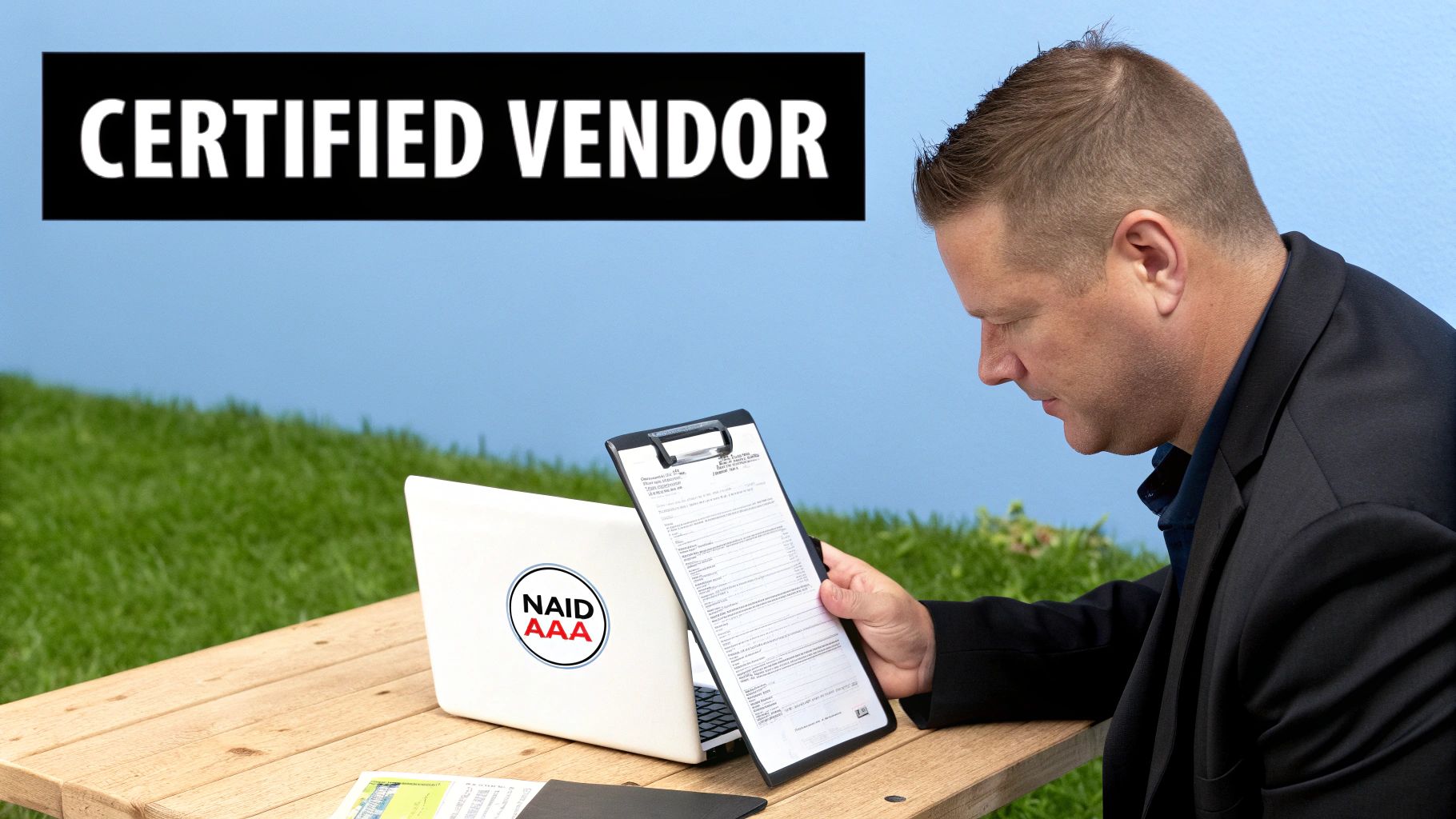
Your vetting process should kick off with one non-negotiable credential: NAID AAA Certification. Think of this as the gold standard for the data destruction industry. It’s not just a fancy sticker on a truck; it’s proof that a vendor has passed rigorous, unannounced audits that scrutinize every single part of their operation.
These audits confirm that critical security protocols are in place, such as:
- Employee Screening: Are all employees handling your media subject to thorough, ongoing background checks?
- Chain of Custody: Is there a secure, documented process from the moment your drives are picked up to their final destruction?
- Access Controls: Is the facility and all equipment locked down against unauthorized access?
- Insurance Requirements: Does the vendor carry enough professional liability insurance to protect you if the worst happens?
When you choose a NAID AAA Certified provider, you know these foundational security measures are already baked into their process. It gives you a solid baseline of trust from the get-go.
Essential Questions For Potential Vendors
Once you've confirmed their certification, it's time to dig a little deeper. Any professional, transparent vendor will welcome your questions. Their answers (or lack thereof) will tell you everything you need to know about their commitment to security and responsible practices.
Start with these critical inquiries:
- Downstream Recycling Policy: What actually happens to the shredded material? A responsible partner will have a fully audited downstream process, ensuring the e-waste is recycled in an environmentally sound way and not just illegally shipped overseas.
- Asset Tracking Capabilities: Can you track each hard drive by its serial number? This level of detail is absolutely crucial for creating a bulletproof audit trail, especially for organizations with strict compliance mandates.
- Logistics and Service Area: How do you handle pickups for businesses outside of major hubs like Birmingham or Mobile? A truly reputable provider will have a robust logistics network capable of serving any business across Alabama, guaranteeing the same security standards no matter where you're located.
A vendor's ability to manage nationwide logistics is a huge indicator of their operational maturity. It shows they have the infrastructure to handle complex projects and serve enterprise clients with multiple locations, delivering consistent service everywhere.
It's also important to understand the full scope of a vendor's capabilities. Some partners are full-service IT asset disposition companies that offer a complete suite of services beyond just shredding, like asset remarketing and comprehensive electronics recycling.
By asking the right questions, you can find a true security partner who is dedicated to protecting your data—and your reputation—from start to finish.
What To Expect During The Shredding Process
So, what actually happens when you hire a professional to shred your hard drives? Knowing the step-by-step process can give you real peace of mind, showing you just how seriously a reputable vendor handles your data. A good partner will have a strict, documented protocol to maintain a transparent and defensible chain of custody, whether they’re working at your Alabama facility or their own.
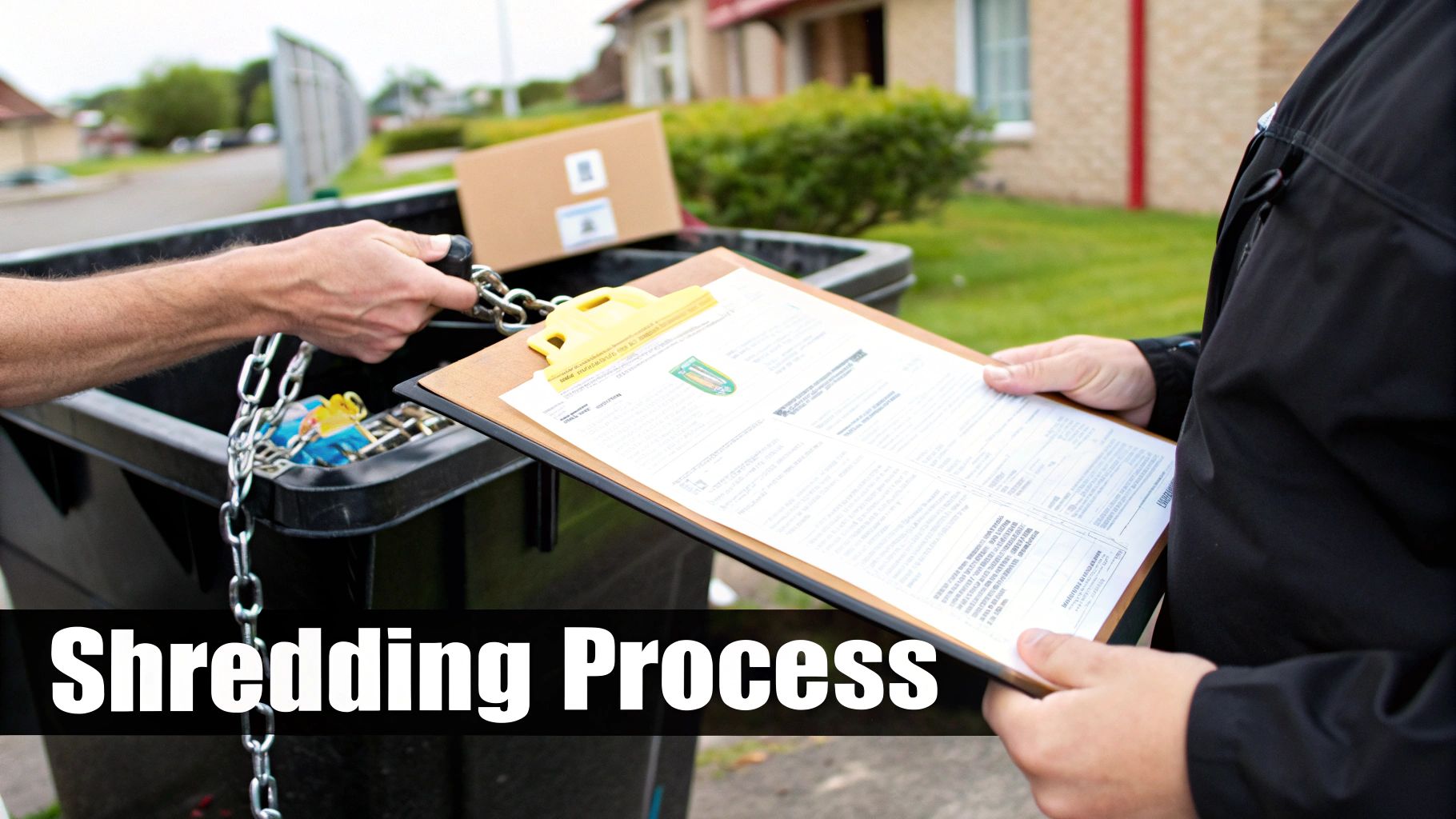
It all starts with a simple consultation. You’ll give the vendor a rough count of the drives you need destroyed and what kind they are—think traditional spinning hard drives (HDDs), solid-state drives (SSDs), or even old magnetic tapes. This helps them give you an accurate quote and line up the right equipment for the job.
Secure Collection And Transport
When the scheduled day arrives, uniformed technicians will show up at your location to collect the assets. This is a critical moment for maintaining that all-important chain of custody.
- Serial Number Scanning: Each and every drive is scanned by its serial number. This creates a detailed inventory that gets matched up with the final Certificate of Destruction.
- Secure Containment: Your drives are immediately placed into locked, tamper-evident security bins right there on-site.
- Documented Handover: You'll sign a transfer of custody form, which officially hands over responsibility for the assets to the vendor.
If you’ve opted for off-site shredding, these locked bins are then loaded into a secure, GPS-tracked vehicle and taken directly to the destruction facility. This meticulous process ensures no drive goes missing from the moment it leaves your hands.
The Destruction Phase And Why It Differs
Now for the main event: the physical destruction that makes your data gone for good. It's crucial to understand that not all shredders are created equal. The technology needed for an old-school HDD is different from what’s required for an SSD, which stores data on tiny microchips scattered across a circuit board.
Physical destruction is the only method the National Institute of Standards and Technology (NIST) considers foolproof for sanitizing modern storage media. Unlike wiping or degaussing, shredding completely pulverizes the physical components, making data recovery impossible.
A certified vendor will use industrial-grade shredders calibrated specifically for the media type, grinding everything into tiny, irregular fragments. This isn't just about smashing things; it's about meeting the highest industry and government compliance standards. To get a better look at the mechanics, you can learn more about why hard drive shredding works so effectively in our guide.
After the last drive has been turned into confetti, you'll receive your Certificate of Destruction. This is more than just a piece of paper—it's a legal document listing the serial numbers of every single destroyed drive. It serves as your official proof that you've disposed of your data securely and compliantly, ready for any audit that might come your way.
Common Questions About Hard Drive Shredding In Alabama
If you're looking into professional data destruction for your business, you probably have a few questions. Alabama businesses often ask about the same things: cost, compliance, and how it all works logistically. Getting straight answers is the only way to make a smart decision that actually protects your company. We’ve pulled together the most common questions we hear to give you some clear, straightforward guidance.
What Does Hard Drive Shredding In Alabama Typically Cost?
There's really no one-size-fits-all price for professional hard drive shredding. The final cost depends on how many drives you have, whether you want the shredding done at your location (on-site) or at a secure facility (off-site), and where you're located in Alabama. Keep in mind that most certified vendors have a minimum service charge to cover their operational costs like fuel and labor.
For smaller commercial jobs, you might see a flat fee for the first group of drives. For instance, some NAID certified providers have set pricing around $150 for the first 10 hard drives. But when you get into larger, enterprise-level projects with hundreds or thousands of drives, the cost per drive drops way down.
Always ask for a detailed quote that breaks everything down—transportation, labor, documentation, and recycling fees. That’s the only way to get full transparency and avoid surprises.
Do I Really Need A Certificate Of Destruction?
Yes, you absolutely do. A Certificate of Destruction isn't just a simple receipt. It’s your official, legal proof that your company did its due diligence to securely destroy sensitive data. This piece of paper is your number one defense in a compliance audit and is non-negotiable for regulations like HIPAA and the FTC Disposal Rule.
By documenting the date, method, and even the serial numbers of the destroyed drives, the certificate effectively transfers the liability from your shoulders to the shredding vendor. Without it, you have no verifiable proof of proper data disposal, leaving your business wide open to major legal and financial headaches.
Can My Business Just Drill Holes In The Hard Drives?
Drilling a hole through a hard drive platter feels pretty destructive, but it's not a compliant or foolproof way to sanitize data for business purposes. It’s certainly a step up from doing nothing, but it’s not enough. Forensic technology has gotten so good that a determined expert can often recover data from damaged platters. A single intact sector can still hold a ton of sensitive information.
Professional shredding, on the other hand, physically pulverizes the drive platters into thousands of tiny, mixed-up fragments. This is the method that meets the tough standards set by the Department of Defense and NIST. Using a certified service is the only way to guarantee the data is gone forever and get the documentation you need for your compliance records.
How Do I Schedule Shredding If My Business Is In Rural Alabama?
That's a valid concern for companies that aren't in a major city like Birmingham or Mobile. The good news is that leading IT Asset Disposition (ITAD) providers like Beyond Surplus have nationwide logistics and pickup capabilities. This model ensures every business can access certified, secure Alabama hard drive shredding, no matter how remote its location is.
The process is simple. You just contact the provider, tell them about your inventory and where you're located, and they handle the rest. They can either dispatch a mobile shredding truck to perform the service right there at your business location or arrange for secure, GPS-tracked transport to pick up the assets for off-site destruction. It’s all designed to make sure every business in Alabama has access to compliant data destruction.
Contact Beyond Surplus for certified electronics recycling and secure IT asset disposal. Beyond Surplus offers certified on-site and off-site hard drive shredding services with nationwide pickup capabilities, ensuring your Alabama business remains compliant and your sensitive data is permanently destroyed. Contact us today for a complimentary quote and to schedule your secure electronics disposal service.