
A pile of retired laptops, failed drives, network gear, and monitors usually triggers the same search. “Recycling e waste near me.” For a household, that search is good enough. For a business, it often points you to the wrong channel.
Consumer drop-off programs are built for convenience. Business disposal is a risk management job. You need documented data destruction, serialized asset tracking, pickup logistics, and records your legal, compliance, and IT teams can effectively use during an audit or internal review.
The distinction is critical because old business devices still hold data, even when they look dead, obsolete, or ready for scrap. If those assets leave your control through a retail counter or local public collection site, you may lose chain of custody before anyone can confirm what was wiped, shredded, recycled, or resold.
Regulated companies have even less room for error. Healthcare groups, financial firms, schools, government contractors, and multi-site enterprises need an ITAD partner that can handle volume, provide certificates, and support secure transportation. A nearby recycler may be local. That does not make it qualified.
If you are starting with a local search, start with a provider built for commercial pickup and certified processing, not household drop-off. Beyond Surplus e-waste recycling near me services is one example of the kind of business-focused option worth evaluating.
The providers below are separated with that standard in mind. Some are useful for consumers. Some are built for enterprise asset disposition. Mixing those categories is where expensive mistakes start.
1. Beyond Surplus
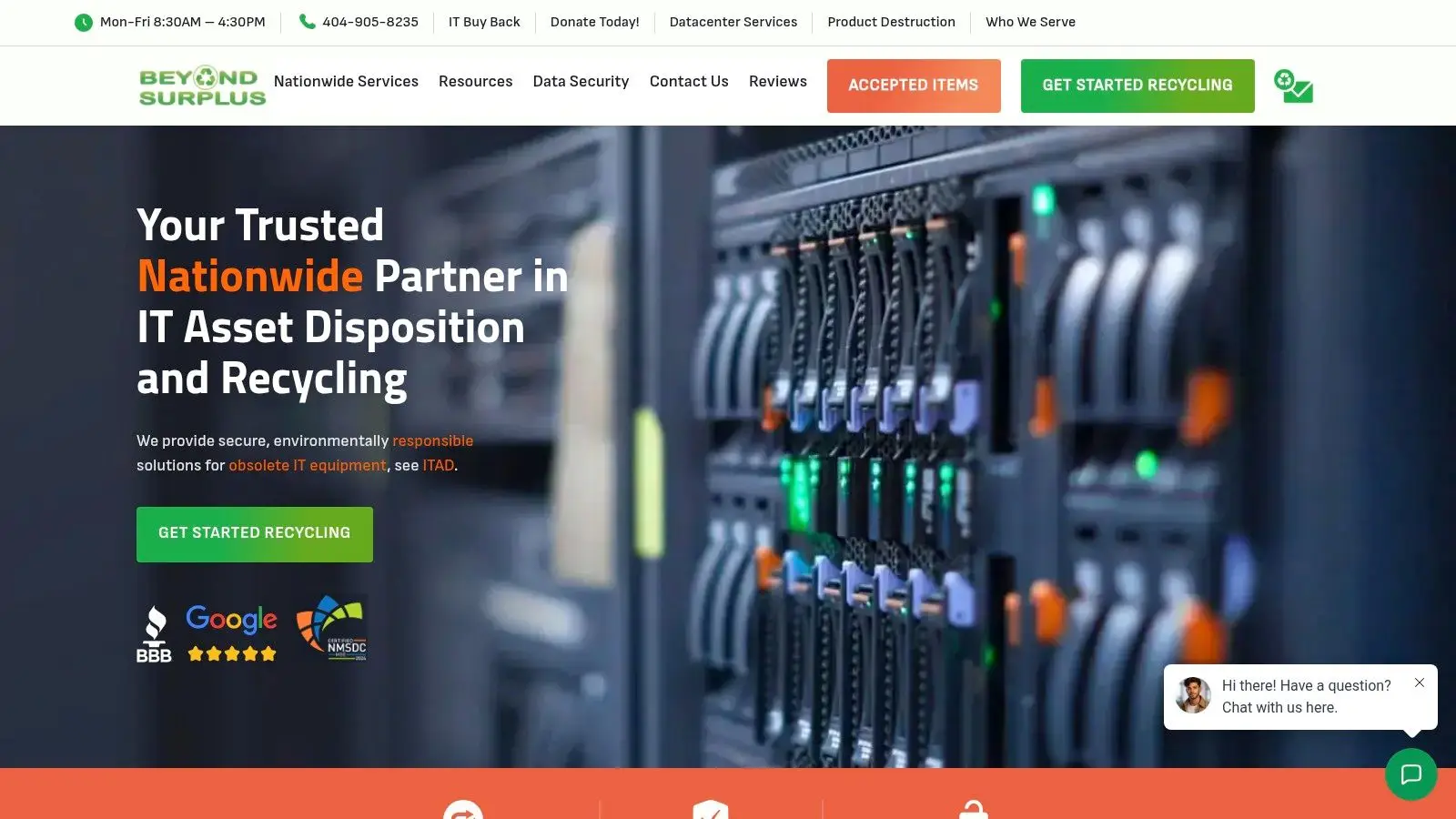
A common scenario: an IT manager searches “recycling e waste near me,” sees consumer drop-off options, and almost sends company laptops into a process built for household junk. That is the wrong move. Beyond Surplus is built for commercial IT asset disposition, where data security, pickup control, and audit records matter as much as the recycling itself.
The service set is what business clients should look for first. Beyond Surplus handles data wiping, on-site and off-site hard drive shredding, certificates of data destruction, certificates of recycling, IT buyback, product destruction, and data center decommissioning. That combination matters because businesses are not just clearing space. They are closing risk, documenting disposition, and managing downstream handling in a way legal, compliance, and IT can defend.
If you are comparing local options, review business alternatives to retail e-waste recycling programs before treating a consumer-facing result as a qualified vendor.
Why it stands out for business use
Pickup control is the distinguishing factor.
Beyond Surplus supports commercial collections with coordinated transportation, serialized handling, and documented downstream processing. That is the standard enterprises need when retired devices may still contain employee records, customer data, financial information, or protected health information. A nearby recycler may be convenient. Convenience does not replace chain of custody.
The other advantage is operational range. Beyond Surplus can handle office cleanouts, recurring refresh projects, server and network gear, and full de-install work. That makes it a practical fit for organizations that want one disposition partner instead of splitting work across movers, recyclers, and destruction vendors.
Practical rule: If a recycler cannot explain pickup custody, data destruction options, and final documentation in plain language, do not release a single business asset.
Best fit and tradeoffs
Beyond Surplus fits companies that need commercial pickup, secure destruction, serialized reporting, and resale value recovery from reusable equipment. It is a stronger match for healthcare, education, finance, government-related contractors, multi-site offices, and any business retiring more than a handful of devices at a time.
Pros:
- Security-focused process: Data wiping and hard drive shredding with formal destruction records.
- Commercial logistics: Pickup coordination, de-installation support, and documented handoffs.
- Value recovery: IT buyback can reduce net disposition cost.
- Audit support: Recycling and destruction certificates support internal reviews and compliance workflows.
- Broad service coverage: Suitable for laptops, desktops, servers, networking gear, and mixed office electronics.
Cons:
- Quote-based pricing: Public rate cards are not the model.
- Business-first scope: This is designed for commercial clients, not casual household drop-off.
Website: Beyond Surplus
2. Best Buy Electronics & Appliances Recycling
Best Buy is one of the most recognizable names that appears when people search “recycling e waste near me.” For households, that visibility makes sense. For businesses, it usually points you in the wrong direction.
Best Buy’s recycling program is designed around retail convenience. You get published item guidance, store-based drop-off, and fees for certain items. That’s useful if someone is clearing out personal electronics. It isn’t a commercial ITAD program.
A lot of business users click retail options because they’re easy to find. Then they realize the limits. There’s no enterprise pickup model, no business chain-of-custody workflow, and no serious compliance posture for sensitive corporate assets. If you’re comparing retail drop-off to a commercial partner, the better benchmark is this guide to Best Buy e-waste recycling alternatives for business.
Where Best Buy works and where it doesn’t
Best Buy is practical for individual consumer items and clearly posted rules. That transparency is a strength. A facilities manager with pallets of retired desktops, though, shouldn’t be trying to route assets through a retail front counter.
Use it for personal convenience. Don’t use it as a substitute for an ITAD vendor.
- Convenient footprint: Many businesses know there’s a store nearby.
- Published rules: Fees, limits, and item acceptance are easier to review than with many local drop-off pages.
- Large-item flexibility: Haul-away options may help for certain appliance categories.
The drawbacks are decisive for commercial users.
- Resident-focused service: It isn’t built for business asset disposition.
- Variable fees: Some electronics categories can carry drop-off charges.
- No audit package: You’re not hiring a compliance-focused ITAD partner.
A retail recycling counter is a convenience service. It’s not a business risk-management solution.
Website: Best Buy Electronics Recycling
3. Call2Recycle
Your office manager is standing over a box of swollen laptop batteries and dead handheld scanners. The immediate problem is safety, not full asset disposition. That is where Call2Recycle fits.
Call2Recycle is a battery and cell phone take-back program. For a business user searching “recycling e waste near me,” that makes it useful in a narrow lane and misleading as a broader answer. It does not solve the harder corporate problem of retiring laptops, desktops, servers, networking gear, or storage media under a documented ITAD process.
Use it for battery collection. Keep it out of the lead role in your disposition policy.
The value is straightforward. Call2Recycle has a large public drop-off network, clear battery handling guidance, and a familiar program structure through its main site: Call2Recycle. If your company generates spent batteries from mobile devices, scanners, tools, or facilities equipment, this can help your team get those items out of the building safely and legally.
That still leaves the primary business risk untouched. Batteries are one waste stream. Data-bearing devices are another.
A sound policy separates them:
- Strong fit for battery programs: Useful for rechargeable batteries, some cell phones, and routine collection needs.
- Accessible collection network: Easier to use than many local hazardous waste options.
- Practical safety support: Packaging and handling instructions reduce avoidable transport mistakes.
The limits matter more than the convenience for commercial users.
- Too narrow for ITAD: It does not cover the full chain of custody businesses need for computers and infrastructure hardware.
- Location rules can vary: Acceptance may depend on battery chemistry, condition, or program setup.
- Business logistics may require extra coordination: Higher-volume use is a different exercise than a staff member dropping off a small box.
If your company is retiring endpoints or anything with storage, treat Call2Recycle as a supporting outlet for batteries, not as your e-waste vendor. A business that confuses those two functions usually ends up with compliance gaps, weak documentation, and the wrong service model for the assets that matter most.
Website: Call2Recycle
4. Dell Reconnect
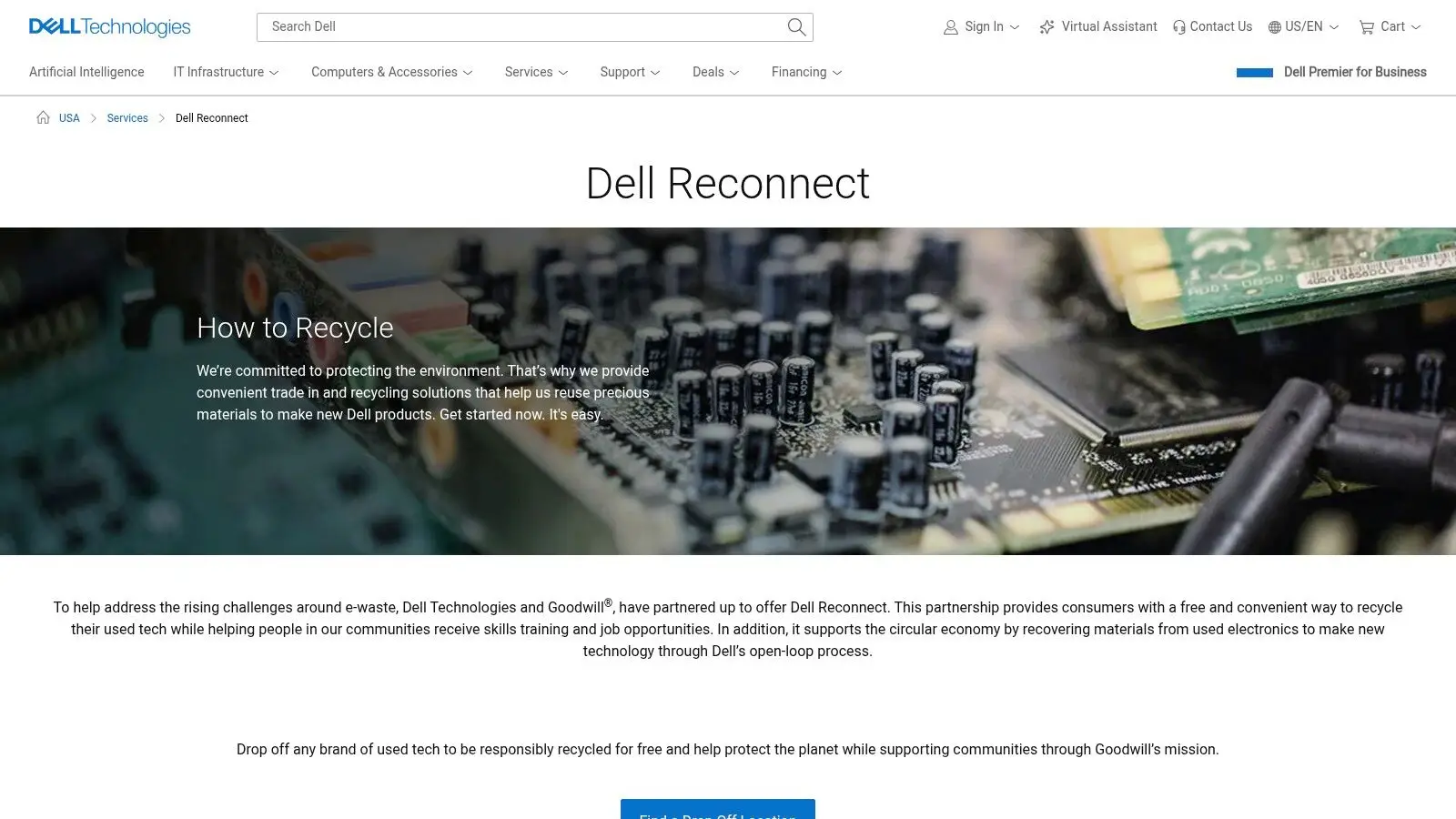
Dell Reconnect is a consumer-friendly program, not a commercial disposition answer. It partners with Goodwill and focuses on free residential electronics drop-off at participating locations. That makes it easy to understand and easy to misuse if you’re a small business trying to solve a corporate asset problem on the cheap.
The reuse angle is legitimate. Devices that can be repaired or reused should stay in circulation. But the business issue isn’t whether reuse is good. It’s whether your company can document what happened to each device and prove data-bearing assets were handled correctly.
Good consumer program, poor enterprise fit
Dell Reconnect has broad public awareness and participating Goodwill locations. The plan notes describe more than 2,000 participating sites nationwide, but even with that reach, the model is still public drop-off. It’s not designed for office cleanouts, chain-of-custody reporting, or enterprise pickups.
That’s the dealbreaker for regulated sectors. If you manage devices used in healthcare, finance, education, or government, consumer convenience doesn’t satisfy your obligations.
If the program starts with “bring it to a store,” it’s probably not built for your decommissioned corporate fleet.
Pros:
- Generally easy to access: Good option for individuals clearing out PCs and peripherals.
- Reuse emphasis: Working equipment may stay in use longer.
- Brand familiarity: Dell and Goodwill are recognizable.
Cons:
- Residential orientation: Not intended for business pickups or business documentation.
- Location variability: Acceptance differs by site.
- Weak fit for sensitive assets: No enterprise-grade destruction workflow.
Website: Dell Reconnect
5. ERI
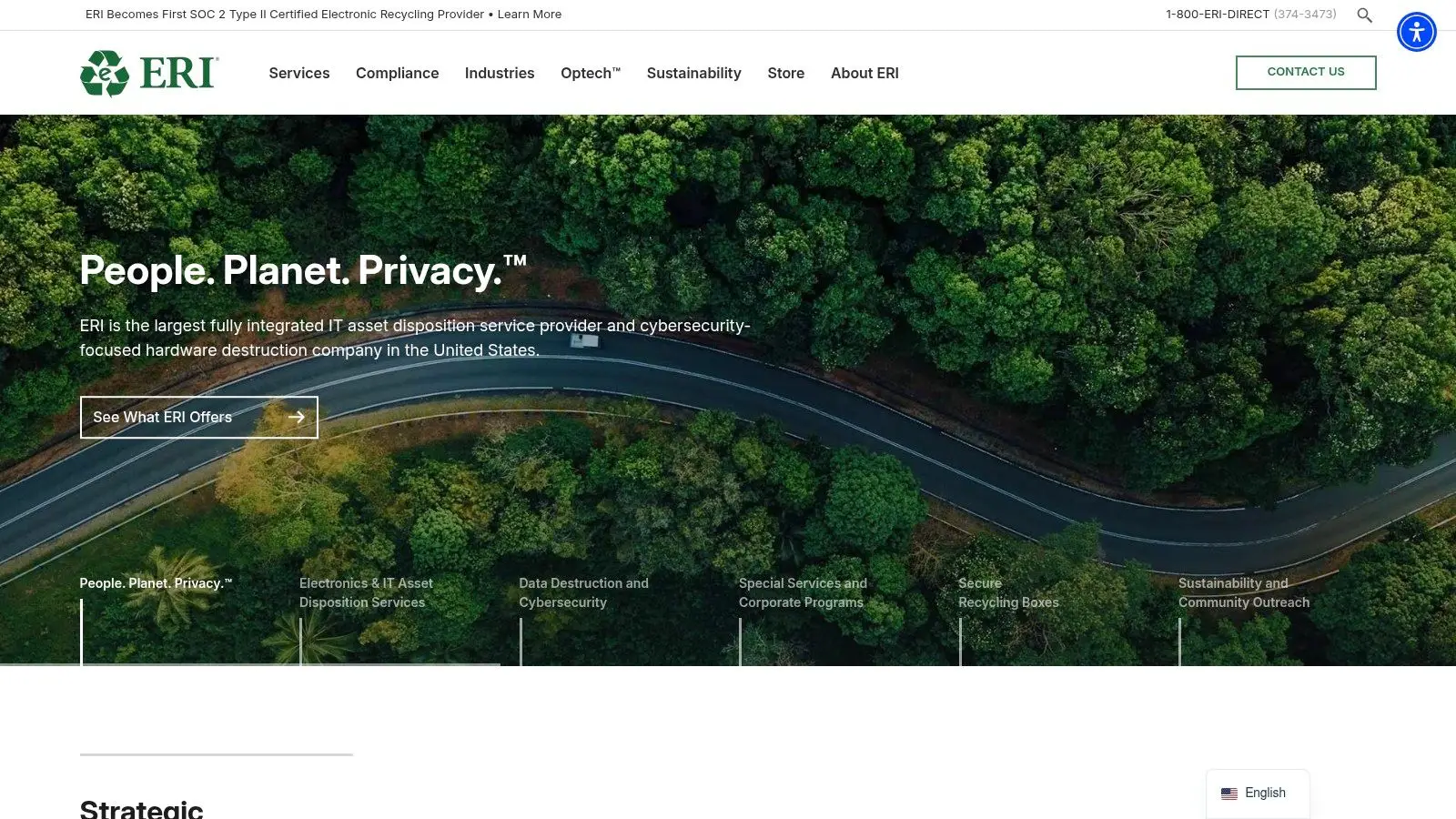
A facilities manager searches "recycling e waste near me" after an office closure and gets a page full of consumer drop-off results. That is the wrong buying path if the project includes company laptops, retired servers, or anything with stored data. ERI is the kind of provider that belongs in that search for business users.
ERI serves enterprise, OEM, and government programs where security, chain of custody, and documented disposition matter as much as recycling itself. If your company needs pickup coordination, serialized reporting, and formal destruction records, ERI fits the commercial ITAD category. It should be evaluated against other enterprise vendors, not against public collection sites.
Enterprise strengths
ERI makes sense for multi-site collections, recurring refresh cycles, and projects large enough to involve procurement, compliance, and internal audit. It also supports reuse and remarketing paths for equipment that still has value, which matters if you want cost recovery instead of treating every device like scrap.
For data-bearing assets, destruction standards should be reviewed before pickup is scheduled. This guide to secure hard drive destruction methods for business equipment is the right benchmark for evaluating any ITAD provider's process.
- Built for commercial volumes: Better fit for enterprise fleets, OEM programs, and public sector work than local drop-off options.
- Security controls: Supports on-site and off-site data destruction with asset tracking.
- Audit support: More suitable for chain-of-custody documentation, certificates, and internal control requirements.
The tradeoff is straightforward. ERI is not a walk-in consumer recycler, and the engagement usually starts with scope, service requirements, and logistics planning.
Website: ERI
6. Sims Lifecycle Services
Your infrastructure team is shutting down a server room, storage arrays are stacked on pallets, and someone types “recycling e waste near me” into Google. That search is too consumer-focused for the job. Sims Lifecycle Services belongs in the enterprise ITAD category, where issues are chain of custody, serialized asset tracking, data destruction, and coordinated logistics across large projects.
SLS fits companies dealing with data center gear, multi-site refreshes, and enterprise redeployment programs. The point is scale, but scale alone is not enough. You also need process discipline. That includes controlled intake, documented downstream handling, and asset value recovery when equipment should be resold or redeployed instead of shredded.
This matters most for backend infrastructure. Racks, network hardware, and storage media create a different risk profile than a few office laptops dropped at a local collection event. If your team is still sorting out the difference between recycling and formal disposition, review this explanation of IT asset disposition services for business equipment.
Where SLS makes sense
SLS is a practical option for organizations that need project-based execution, not public drop-off convenience. It supports on-site and off-site services, coordinated transportation, and remarketing paths for equipment that still carries value.
- Data center focus: Better suited to server, storage, and network decommissioning than consumer recycling programs.
- Enterprise logistics: Useful for regional or national projects involving multiple facilities, phased pickups, and controlled processing.
- Recovery potential: Supports reuse and resale decisions so retired assets are not automatically treated as scrap.
The limitation is straightforward. SLS is built for scoped commercial engagements. If a business user searches “recycling e waste near me,” this is the type of provider they should evaluate when the project involves infrastructure, sensitive media, or formal reporting requirements.
Website: Sims Lifecycle Services
7. Iron Mountain Asset Lifecycle Management
Iron Mountain’s IT asset disposition offering is built for organizations that already think in terms of audit trails, serialized inventories, and documented destruction. If your business handles regulated information, that mindset is a better fit than a local recycler that mainly advertises convenience.
What stands out is the combination of on-site and off-site destruction with broader enterprise logistics. That gives companies options when assets can’t leave the premises intact or when central processing makes more operational sense.
Why regulated sectors choose this model
A healthcare network, financial institution, or government agency typically needs more than recycling. It needs evidence. Iron Mountain is designed around that expectation with certificates, inventory control, and formal service workflows.
The verified brief notes that one underserved issue in this search category is secure data destruction compliance and the difference between on-site and off-site shredding for chain of custody, discussed in the Smyrna e-waste compliance overview. That’s exactly why enterprise buyers end up with vendors like Iron Mountain instead of consumer programs.
If your team is still sorting out terminology, this explanation of what IT asset disposition means is the right place to start.
Business e-waste is an information security project first, a recycling task second.
Pros:
- Audit-ready documentation: Strong fit for regulated industries.
- Flexible destruction options: On-site and off-site handling depending on policy.
- National reach: Works well for multi-location organizations.
Cons:
- Not consumer-facing: No value for a casual walk-in need.
- Quote-based pricing: Premium controls usually require detailed scoping.
Website: Iron Mountain IT Asset Disposition
7-Provider Comparison: E-Waste Recycling Near Me
| Service | Implementation Complexity 🔄 | Resource Requirements ⚡ | Expected Outcomes 📊 | Ideal Use Cases 💡 | Key Advantages ⭐ |
|---|---|---|---|---|---|
| Beyond Surplus | Moderate–High: coordinated on‑site/off‑site shredding and logistics | Own fleet + vetted carriers, certified wiping/shredding equipment; quote‑based costs | Certified data destruction, chain‑of‑custody, value recovery | Businesses, data centers, healthcare, finance, government needing compliance | End‑to‑end logistics; certified destruction; sustainability focused |
| Best Buy Electronics & Appliances Recycling | Low: retail drop‑off process with published rules | Store drop‑off points, published fees, haul‑away for large items | Convenient residential recycling; clear fees/limits; no corporate certification | Consumers/residents needing local, quick drop‑off or haul‑away | Wide retail coverage; transparent pricing; convenient haul‑away |
| Call2Recycle | Low: simple public battery/cellphone drop‑off network | Partner drop‑off sites; basic safety packaging guidance | Safe battery recycling with broad access; supports EPR compliance | Consumers recycling batteries/cellphones; community stewardship programs | Very broad coverage; typically free; clear safety guidance |
| Dell Reconnect (Dell + Goodwill) | Low: community drop‑off through Goodwill partners | Goodwill locations handle intake; refurbishment pipelines | Reuse/refurbish where possible; responsible recycling; no corporate docs | Residents clearing PCs/peripherals who want reuse/donation | Free residential drop‑off; reuse emphasis; community distribution |
| ERI (Electronic Recyclers International) | High: enterprise ITAD with serialized tracking and facility certifications | Certified facilities (e‑Stewards/NAID), scalable logistics, remarketing teams | Certificates of destruction, compliance documentation, scalable recovery | Large enterprises, OEMs, governments with multi‑site programs | Deep enterprise experience; strong compliance posture; scalable logistics |
| Sims Lifecycle Services (SLS) | High: global ITAD and data center decommissioning workflows | Large facilities + vetted subcontractors, circular centers for repair/remarketing | Chain‑of‑custody, secure handling, high‑volume redeployment/remarketing | Hyperscalers, large enterprises, data center decommissions | Global reach; circular repair/remarket centers; enterprise security |
| Iron Mountain Asset Lifecycle Management / ITAD | High: mature, audit‑ready secure destruction and tracking | Global standardized processes, serialized inventory, on‑site/off‑site capabilities | Rigorous audit trails, certificates, redeployment and remarketing | Regulated industries and organizations needing enforceable audit documentation | Strong documentation/compliance framework; flexible service models |
Partner with Beyond Surplus for Secure, Certified ITAD Services
Your operations manager searches “recycling e waste near me” after an office move or hardware refresh. The results look convenient. They are usually built for household drop-offs, not for a business that has drives, regulated data, asset records, and a pickup schedule to meet.
That distinction decides whether your company gets documented disposition or unnecessary exposure.
Consumer recycling options serve a purpose. They help with a few personal devices, batteries, or small public drop-offs. Business equipment belongs in an ITAD program that controls custody, records serials, manages data destruction, and supports resale or recycling at commercial scale. If your team is decommissioning laptops, servers, network gear, or storage media, treat that work as risk management, not simple recycling.
The business case is not just environmental. Proper disposition also protects data, preserves audit documentation, and recovers value from reusable equipment. Organizations that treat enterprise assets like household e-waste usually create avoidable problems. Missing chain-of-custody records, unclear destruction status, and poorly planned pickups cost more than they save.
Use this standard:
- Send household-type items to consumer programs: personal electronics, loose batteries, and one-off public drop-offs.
- Send company-owned IT to an ITAD provider: any asset with storage media, inventory controls, or compliance obligations.
- Require documentation: certificates of data destruction, recycling records, serialized tracking, and custody logs.
- Build logistics around volume: palletization, on-site packing, pickups, de-installs, and multi-location coordination.
- Recover value where possible: redeployment, remarketing, and buyback should be part of the plan, not an afterthought.
Beyond Surplus fits the business side of this search because it offers the services commercial clients need: secure data wiping, on-site and off-site shredding, recycling certificates, data destruction certificates, IT buyback, product destruction, and pickup support across the contiguous United States. That is a practical fit for office closures, refresh cycles, warehouse cleanouts, and data center projects where consumer drop-off options are the wrong tool.
Keep your selection criteria strict. Choose a provider that can document every handoff, destroy data in a defensible way, and remove equipment without disrupting your operation. Beyond Surplus meets that standard.
Contact Beyond Surplus for certified electronics recycling, secure data destruction, IT asset disposition, and nationwide business pickup built for compliance, chain-of-custody control, and value recovery.